
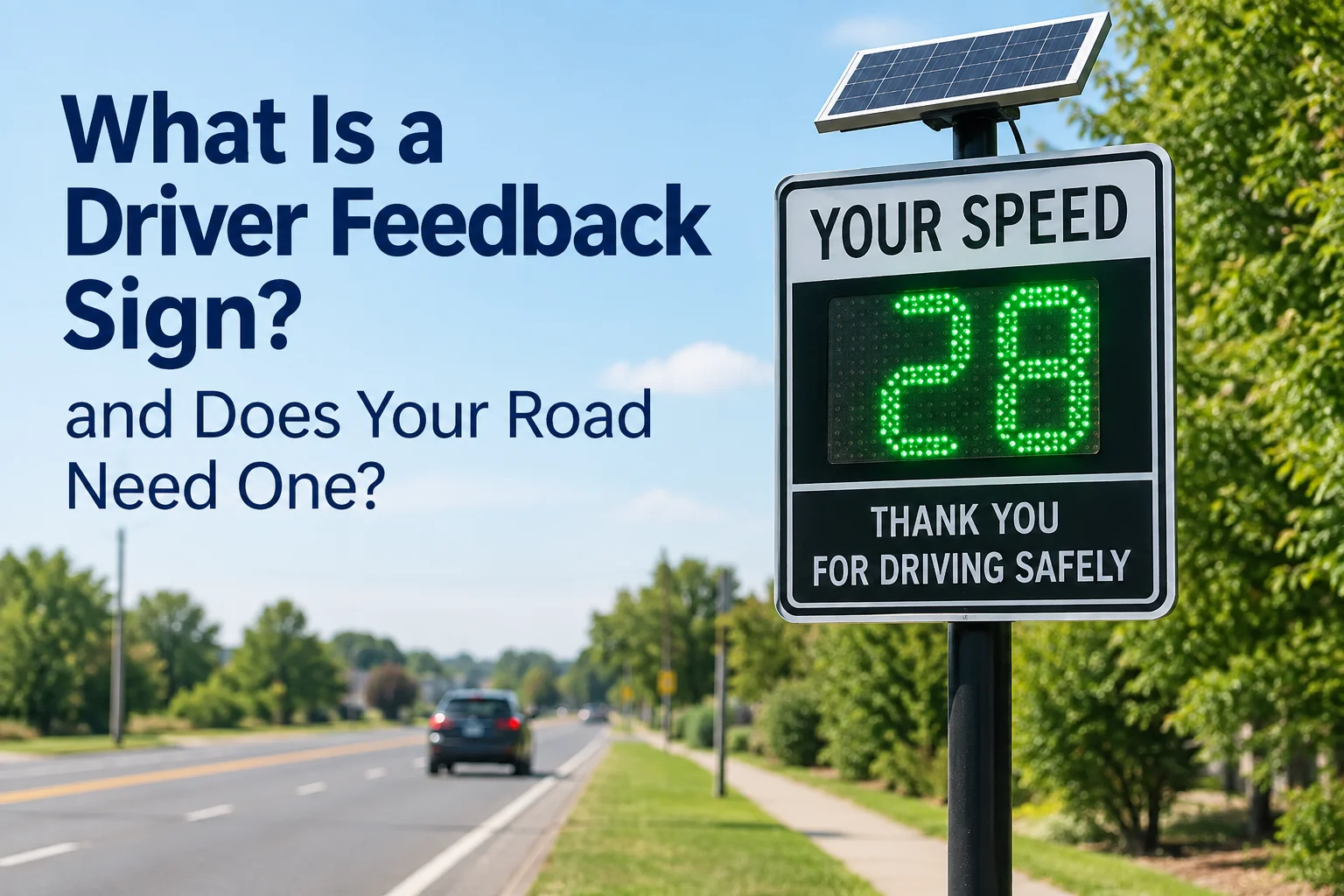
A driver going 10 mph over the limit rarely sees the sign that would make them slow down. A driver feedback sign changes that, by showing each driver their own speed in real time, on the spot, before the risky stretch of road. It is one of the few traffic-calming tools that influences behaviour instantly, without a fine or a citation.
This guide explains what a driver feedback sign is, how it works, where it belongs, and the safety data that backs it up. If you are weighing it against other visibility tools for a project, see our guide on road safety equipment for construction sites or browse our full road safety product range.
A driver feedback sign, also called a radar speed sign or “your speed is” sign, is a roadside display that uses radar to detect an approaching vehicle’s speed and shows that speed back to the driver on a large digital display. Most units also flash, change colour, or show a slow-down icon when a vehicle exceeds the posted limit.
Unlike a fixed speed limit sign, a driver feedback sign is interactive. It responds to each individual driver in real time, which is what makes it effective at prompting an immediate, voluntary reduction in speed rather than relying on a driver’s memory of the posted limit.
Driver feedback signs work best where drivers are likely to be travelling faster than they realise, or where a small reduction in speed meaningfully reduces risk. Common deployment points include:
The core finding behind driver feedback signs is consistent across traffic studies: showing drivers their actual speed, in the moment, produces a measurable and immediate reduction in average speed, often most pronounced among the fastest-moving vehicles, the group responsible for the most severe outcomes if a crash occurs.
The effect is strongest in the first few hundred feet after the sign and tends to fade with distance, which is why placement matters as much as the sign itself. Many agencies install feedback signs ahead of the specific hazard, such as a school crossing or sharp curve, rather than at the start of a long straight road, so the speed reduction is still in effect when the driver reaches the risk point.
Factor | Standard speed limit sign | Driver feedback sign |
Message | Static, same for every driver | Personalised to each driver’s actual speed |
Engagement | Passive, easy to tune out | Active, hard to ignore |
Data collection | None | Often logs speed and volume data |
Typical effect on speed | Limited on its own | Measurable, immediate reduction |
Cost | Low | Higher, but no fines or enforcement staff required |
Yes. Studies consistently show a measurable drop in average and 85th-percentile speeds immediately after a feedback sign is installed, particularly among drivers travelling well over the limit.
No. Standard driver feedback signs only display speed; they do not identify vehicles or issue citations. Their effect comes from immediate driver awareness, not enforcement.
Not necessarily. Many models run on battery or solar power, which makes them practical for locations without an existing electrical connection.
Just ahead of the specific risk, such as a school crossing, sharp curve, or the point where a speed limit changes, rather than at the start of a long stretch of road.
Yes. Many HOAs, business parks, and campuses install driver feedback signs on internal roads to manage speed without needing municipal enforcement.
A driver feedback sign is one of the simplest ways to cut speed at a specific risk point, with no fines, no enforcement staff, and a track record of measurable results. If you are planning signage alongside other visibility upgrades, pair it with our guide on solar vs reflective road studs for the rest of the road. When you are ready to spec a sign for your site, contact DM Road Safety for options and pricing.
DM Road Safety supplies radar-based driver feedback signs built for continuous outdoor use. Tell us your road type, speed limit and power setup (mains or solar) and we will recommend the right model and send a quote.