
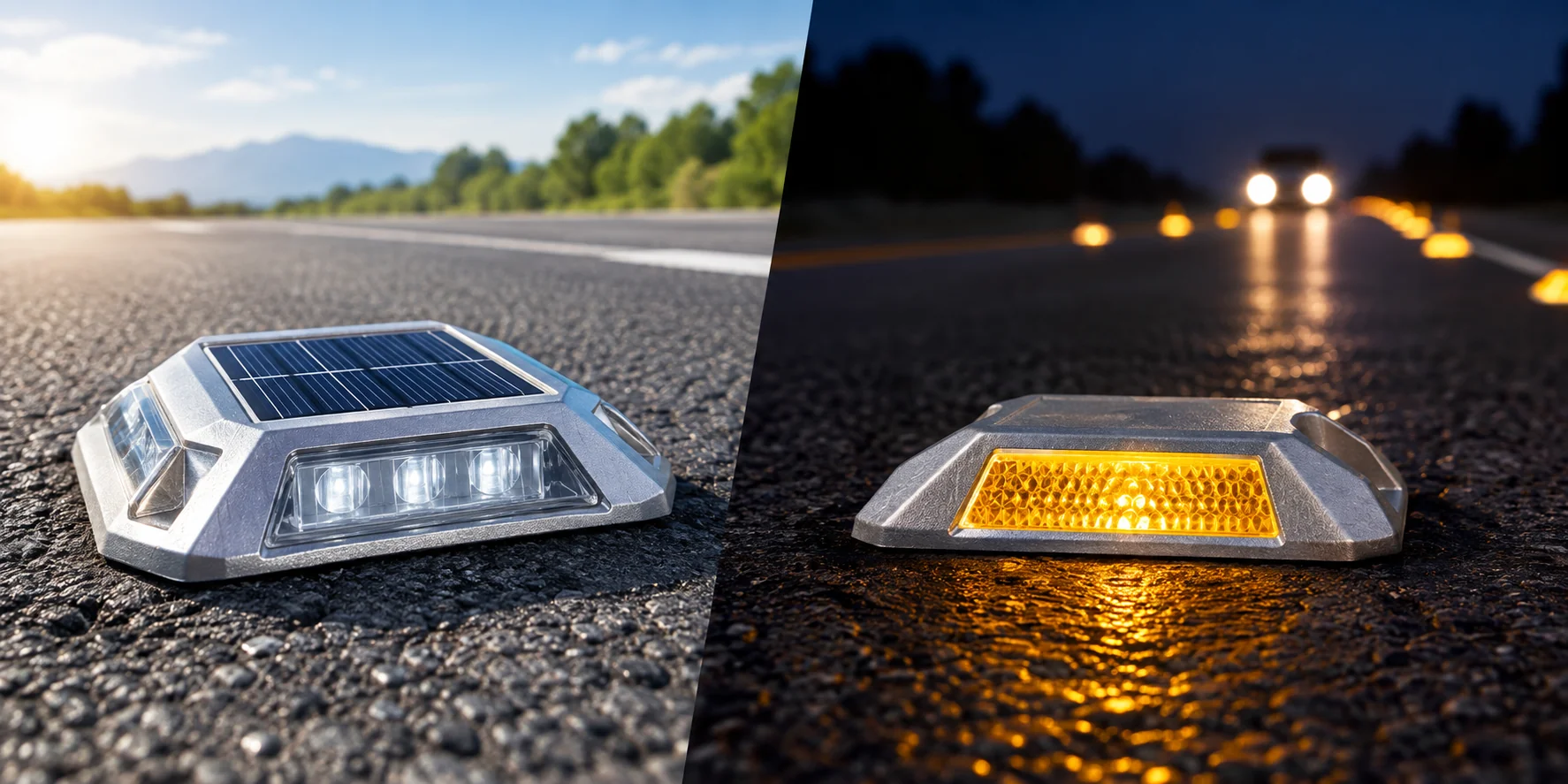
Choosing between solar and standard reflective road studs looks like a simple price decision. It is not. A reflective stud costs far less on the day you buy it, but the cheapest stud on paper is not always the cheapest stud on the road. Visibility in poor weather, maintenance visits and replacement cycles all change the real cost.
This guide compares solar vs reflective road studs on upfront cost, maintenance, performance in fog and rain, and lifespan. It also gives you a simple five-year framework to make the decision for your own project. If you are still narrowing down stud types in general, start with our guide on how to choose road studs for highway projects.
Reflective road studs (often called cat eyes) contain retroreflective lenses that bounce a vehicle’s headlight beam back to the driver. They need no power, so they work only when headlights shine on them.
Solar road studs contain LEDs, a small solar cell and a rechargeable battery. They charge during the day and switch on automatically at dusk, so they glow whether or not a headlight is pointing at them. You can see the full range on our road studs page.
|
Factor |
Standard reflective studs |
Solar road studs |
|
Upfront cost per unit |
Low |
Higher (typically several times more) |
|
How it works |
Reflects vehicle headlights |
Self-powered LED, charges by day |
|
Visibility range |
Depends on headlight distance |
Longer, does not depend on headlights |
|
Fog, rain, heavy dust |
Reduced when the lens is wet or dirty |
Stronger, active light cuts through |
|
Power / wiring |
None |
None (built-in solar cell and battery) |
|
Maintenance |
Occasional lens cleaning, replacement after impact |
Panel cleaning, battery ageing, replacement after impact |
|
Best fit |
Long, straight lit roads, tight budgets |
Curves, junctions, unlit and remote roads, fog-prone areas |
Reflective studs win here without contest. Solar studs carry the price of LEDs, a solar cell, a battery and a sealed, impact-resistant housing, so the per-unit price is typically several times higher. On a long highway with thousands of units, that gap becomes a serious budget line.
Installation cost is similar for both. Neither needs trenching or wiring, which is the main reason solar studs are practical on remote roads where running cable would be far more expensive.
Reflective studs depend on headlights. Their effective range is limited by the beam, and their performance drops when lenses are covered in mud, dust or standing water. That matters on rural and mountain roads where dust, rain and fog are common.
Solar studs produce their own light, so drivers can see the road edge or lane line from further away and earlier on curves. This is the strongest argument for solar: extra reaction time at the places where crashes are most likely, such as sharp bends, junctions and unlit stretches.
Both types are exposed to traffic, so impact damage is the most common reason either one fails. Beyond that:
Actual lifespan depends on traffic volume, climate, installation method and product quality, so always ask your supplier for the warranty period and test data, not just a headline number.
To compare fairly, calculate cost per unit over the time you actually plan to keep the studs in service:
5-year cost per stud = purchase price + installation + (expected replacements x replacement cost) + maintenance
Run the formula for both types using real quotes. For example, if a cheaper reflective stud needs replacing twice in five years on a heavily trafficked road while a solar stud lasts the full period, the gap narrows quickly. On a quiet, well-lit road where studs rarely get damaged, reflective usually stays cheaper. The figures above are a method, not a price list. Use quotes for your own site.
Best of both: many projects use reflective studs along the full length and add solar studs only at high-risk points. This keeps the budget under control while giving extra warning where it counts. For the wider equipment list on a project, see our road safety equipment guides or browse the full road studs range.
|
Need road studs for your next project? DM Road Safety supplies reflective and solar road studs, delineator posts and other road safety products in bulk. Tell us your road type, quantity and location and our team will recommend the right option and send a quote. |
There is no universal winner in the solar vs reflective road studs debate. Reflective studs win on price and simplicity, solar studs win on visibility and reaction time. Match the stud to the risk profile of the road, run the five-year numbers, and consider a mixed layout. When you are ready, contact DM Road Safety for specifications and a bulk quote.
They are worth it where visibility is the main risk: unlit roads, curves, junctions and fog-prone areas. On straight, well-lit roads, standard reflective studs are usually the better value.
Yes. They charge from ambient daylight, not only direct sun, though a long run of very dark weather can reduce brightness. Check battery capacity and charging specs with your supplier.
No. They work by reflecting headlight beams, so there is no battery or wiring to maintain.
It varies with traffic volume, climate, installation quality and product grade. Ask for warranty terms and test data before ordering.
Yes, and it is a common approach: reflective studs for continuous delineation and solar studs at curves, junctions and crossings.