
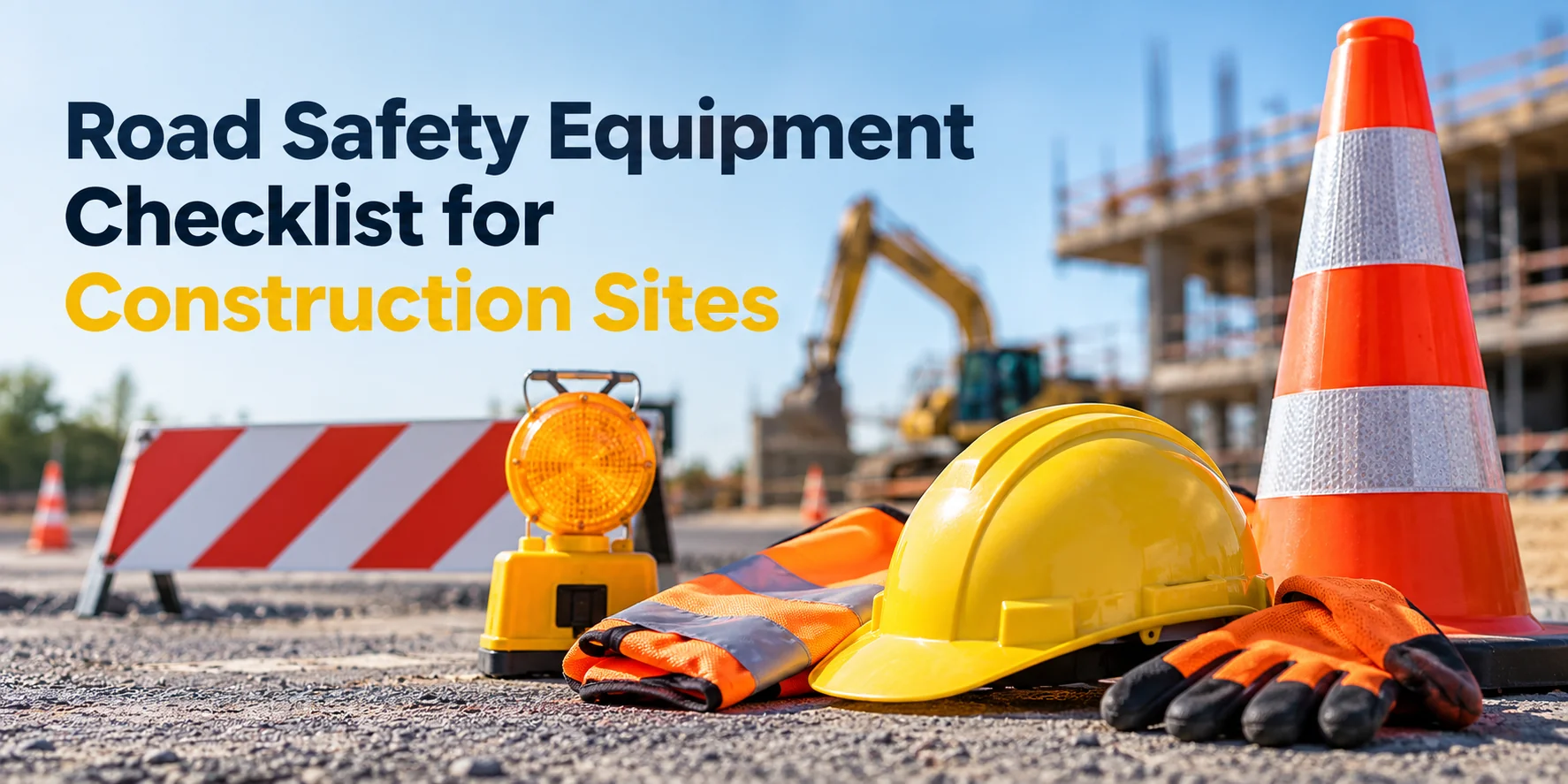
A construction site is a controlled hazard zone, and the road safety equipment you set up before breaking ground decides who goes home safe. Haulage trucks reverse, excavators swing, and public traffic keeps moving a few metres away. One missing sign or a worn-out cone line can turn a routine shift into an incident report.
Quick answer: The essential road safety equipment for a construction site is reflective warning and regulatory signs, traffic cones and channelizers, barriers or barricades, delineators and posts, road studs for lane guidance, speed breakers for on-site speed control, and PPE-adjacent items such as high-visibility gear and warning lights. Check every item against your traffic management plan before mobilization.
This checklist walks through each category in the order a site manager should verify it, with notes on what to look for and where to source it. Use it as a printable pre-mobilization sheet, then hand it to your procurement team.
Most sites need seven core categories. Here is the short version before we go through each in detail:
Category | What it does | Typical use on site |
|---|---|---|
Reflective signs | Warn, regulate and direct road users | Approach warnings, speed limits, diversions |
Traffic cones | Guide and separate traffic flow | Tapers, lane closures, temporary works |
Barriers and barricades | Physically block or separate zones | Excavations, pedestrian routes, work areas |
Delineators and posts | Mark edges and alignment | Haul roads, curves, site entrances |
Road studs | Light up lane lines at night | Temporary diversions, access roads |
Speed breakers | Force vehicles to slow down | Site gates, haul roads, parking areas |
PPE-adjacent items | Make people and plant visible | Flaggers, spotters, night shifts |
A checklist turns safety from a good intention into a verifiable step. Three things make it worthwhile:
Before you work through the list, confirm your traffic management plan. It defines taper lengths, speed limits, sign placement and pedestrian routes, and every quantity below should come from it.
Signs are your first line of communication with drivers, so they must be readable at speed, in rain and after dark. The sheeting grade matters as much as the message.
What to check: Retroreflective performance and sheeting type. For short-term, low-speed site roads, Engineer Grade Type I sheeting is a practical, economical choice. For higher-speed approaches, longer projects or busy night operations, step up to HIP Grade Type IV or Diamond Grade Type XI for stronger visibility at distance. If you are unsure which suits your site, our guide to engineer grade vs diamond grade reflective sheeting breaks down the difference.
Cones are the most-used item on any site, which also makes them the most commonly under-ordered. They form tapers, mark closures, and separate vehicles from workers.
What to check: Cones should stand upright after impact, stay flexible in heat and cold, and carry intact reflective bands. Browse our traffic cones range to match heights and base weights to your site conditions. Buying in volume cuts per-unit cost, so a bulk traffic cones supplier that can also deliver signs and studs in the same order saves coordination time.
Cones guide drivers, but barriers stop them. Use them wherever a vehicle strike or a fall would cause serious harm.
What to check: Stability in wind, visibility at night, and clear gaps for emergency access.
Delineators outline the intended path, particularly on curves, haul roads and temporary diversions where there are no permanent road markings.
What to check: Flexible posts that spring back after vehicle contact reduce replacement costs on busy sites.
Painted lines wear quickly under construction traffic, and temporary lines are hard to see in rain. Road studs, also called cat’s eyes, give drivers a clear lane reference after dark.
What to check: Reflectivity, impact resistance and compatibility with your surface type. Explore the road studs category to compare options.
Site vehicles are a leading hazard for workers on foot. Speed breakers slow trucks and vans where it matters most: gates, loading zones, haul road crossings and parking areas.
What to check: Choose a unit that handles your heaviest vehicles and can be repositioned without drilling if the layout will change. For a modular option, look at the ETEP Plastic Speed Breaker Type 1. If you are comparing materials, our guide on plastic vs rubber speed breakers explains the trade-offs.
Many incidents happen at dawn, dusk and night, so visibility aids deserve their own checklist line.
Personal protective equipment is outside traffic hardware, but it completes the system. A flagger in the wrong colour vest can undo every sign you installed.
Quantities depend on the length of the work zone, road speed and project duration, so always take final numbers from your traffic management plan. As planning starting points:
A good rule is to inventory your existing stock first. Only order the gap.
Bulk purchasing saves money, but only when quality holds up. When you evaluate a road safety products wholesale supplier, ask:
You can see the full range on our shop page or request a quote for a bundled order.
Before you break ground, confirm that you have:
Work zones typically require warning and regulatory signs, traffic cones or channelizers, barriers, delineators, warning lights, and high-visibility PPE for workers. Exact requirements depend on the governing standard and your approved traffic management plan.
The number depends on the length of the closure, the taper requirements for the road speed, and the spacing in your plan. Calculate from the plan, then add roughly 10–15% for damage and loss.
Engineer Grade Type I suits short-term, low-speed site roads. High Intensity Prismatic and Diamond Grade sheeting work better on faster roads, longer projects and heavy night operations because they stay visible from a greater distance.
Not every site does, but they are strongly recommended where vehicles share space with workers on foot, such as gates, loading areas and haul road crossings. They make drivers slow down in a way signs alone cannot.
Check equipment at the start of each shift and after severe weather or any vehicle strike. Replace faded, cracked or non-reflective items immediately, and keep a simple inspection log.
Choose a supplier that can deliver signs, cones, studs and speed breakers together, with clear product specifications and repeat-order support. DM Road Safety supplies reflective sheeting, road studs, cones and speed breakers for construction and infrastructure projects.
Ready to equip your site? DM Road Safety supplies reflective sheeting, traffic cones, road studs and speed breakers in bulk for construction projects. Browse the shop or request a quote and get your site-ready checklist filled in one order.