
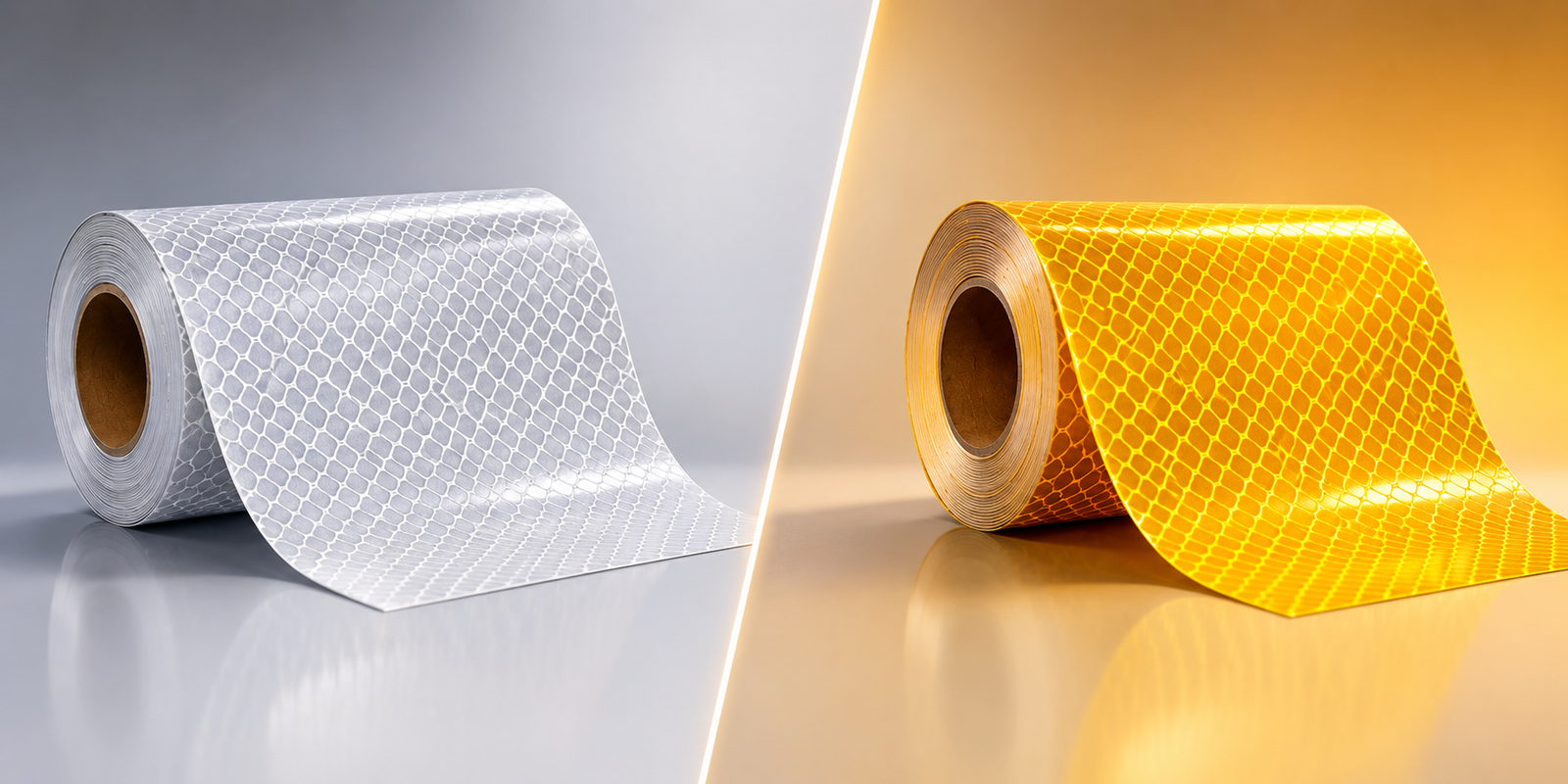
Choosing the right reflective sheeting grade affects how visible your signs are at night, how long they last, and how much you’ll spend replacing them. Here’s a straight comparison of Engineer Grade and Diamond Grade sheeting to help you specify the right one for the job.
A parking lot sign and a rural highway warning sign face very different visibility demands, traffic speeds, and safety stakes. Engineer Grade and Diamond Grade sit at opposite ends of the reflective sheeting spectrum, and knowing the gap between them is the difference between a sign that lasts over a decade and one you’re replacing every few years.
Engineer Grade sheeting, classified as ASTM Type I, is the entry-level standard in retroreflective sign material. It uses enclosed glass-bead technology, where light passes through tiny beads, bounces off a mirrored backing, and returns to its source, a proven approach that still meets minimum federal and state reflectivity requirements for many applications.
Where it typically shows up:
Engineer Grade is visible from roughly 500 feet under headlight illumination and generally holds up for 5 to 7 years before reflectivity drops below usable levels, depending on climate exposure and installation angle.
Diamond Grade sheeting, classified as ASTM Type XI, is the top tier of retroreflective performance for road signage. Instead of glass beads, it uses a full-cube prismatic microstructure, precisely angled micro-prisms that reflect light far more efficiently, sending as much as 60% of available light directly back toward the driver’s eyes.
Where it typically shows up:
Diamond Grade signs are legible from roughly 1,300 to 1,600 feet away and typically maintain strong reflectivity for 12 years or more, making it the standard specification for most modern DOT and municipal road sign programs.
Attribute | Engineer Grade (Type I) | Diamond Grade (Type XI) |
Technology | Encapsulated glass beads | Full-cube prismatic microstructure |
Typical daytime visibility | ~500 ft | ~1,300–1,600 ft |
Light reflected back to driver | Lowest of common grades | Up to ~60% of available light |
Typical service life | 5–7 years | 12+ years |
Best-fit applications | Property, parking, and other non-critical signage | Regulatory, warning, and guide signs on public roadways |
Relative material cost | Lowest upfront cost | Higher upfront cost, lower lifecycle cost |
MUTCD/ASTM relevance | ASTM Type I — minimum sheeting for low-speed, low-risk locations | ASTM Type XI — specified where maximum retroreflectivity and driver reaction time matter most |
Need Type I sheeting for a lower-traffic or property signage project?
Explore the product page
On paper, Diamond Grade costs more per square foot than Engineer Grade. But sheeting is only part of the equation, labor, fabrication, and mounting hardware are largely fixed whether you’re hanging Engineer Grade or Diamond Grade sheeting. When a Diamond Grade sign lasts twice as long, you’re not paying those installation costs twice within the same period.
For agencies managing large sign inventories, that lifecycle math tends to favor Diamond Grade wherever visibility and safety are priorities — even though the sticker price per sheet is higher. Engineer Grade still makes sense where budgets are tight or the sign sits somewhere drivers aren’t relying on it at speed.
A quick way to think about it:
Ready to spec maximum-performance sheeting for a public roadway or regulatory sign?
Explore the product page
Is engineer grade sheeting still legal for road signs?
Engineer grade (Type I) sheeting still meets minimum ASTM and MUTCD thresholds, but many agencies have moved away from it for public roadway signage in favor of higher-performing grades. It remains a common, cost-effective choice for private property, parking lots, and other low-speed, non-critical applications.
How much longer does diamond grade sheeting actually last?
Field data generally shows engineer grade sheeting lasting 5 to 7 years before replacement, while diamond grade sheeting routinely holds its reflectivity for 12 years or more, meaning one diamond grade installation can outlast two or more engineer grade replacements.
Why does diamond grade cost more upfront?
Diamond grade sheeting uses a full-cube prismatic microstructure that’s more efficient, and more expensive to manufacture — than the glass-bead technology in engineer grade sheeting. That efficiency drives its higher reflectivity and longer service life, which typically offsets the higher upfront cost over time.
Which grade does the MUTCD require for regulatory signs?
Requirements vary by sign type, roadway classification, and jurisdiction, so agencies should confirm current specs with their state DOT and the MUTCD. As a general pattern, regulatory, warning, and guide signs on public roads increasingly call for high intensity prismatic or diamond grade sheeting, while engineer grade is reserved for lower-risk applications.
Can I mix sheeting grades within the same sign program?
Yes. Many agencies and facility owners use engineer grade sheeting for parking and property signage while specifying diamond grade for public roadway and high-speed corridor signs. The right approach is to match the grade to the sign’s function, traffic speed, and visibility requirements rather than standardizing on one grade for every application.
Matching the sheeting grade to the application keeps your signs visible, compliant, and cost-effective over their full service life. Browse our Engineer Grade and Diamond Grade options below, or reach out to our team for help specifying the right material for your project.